
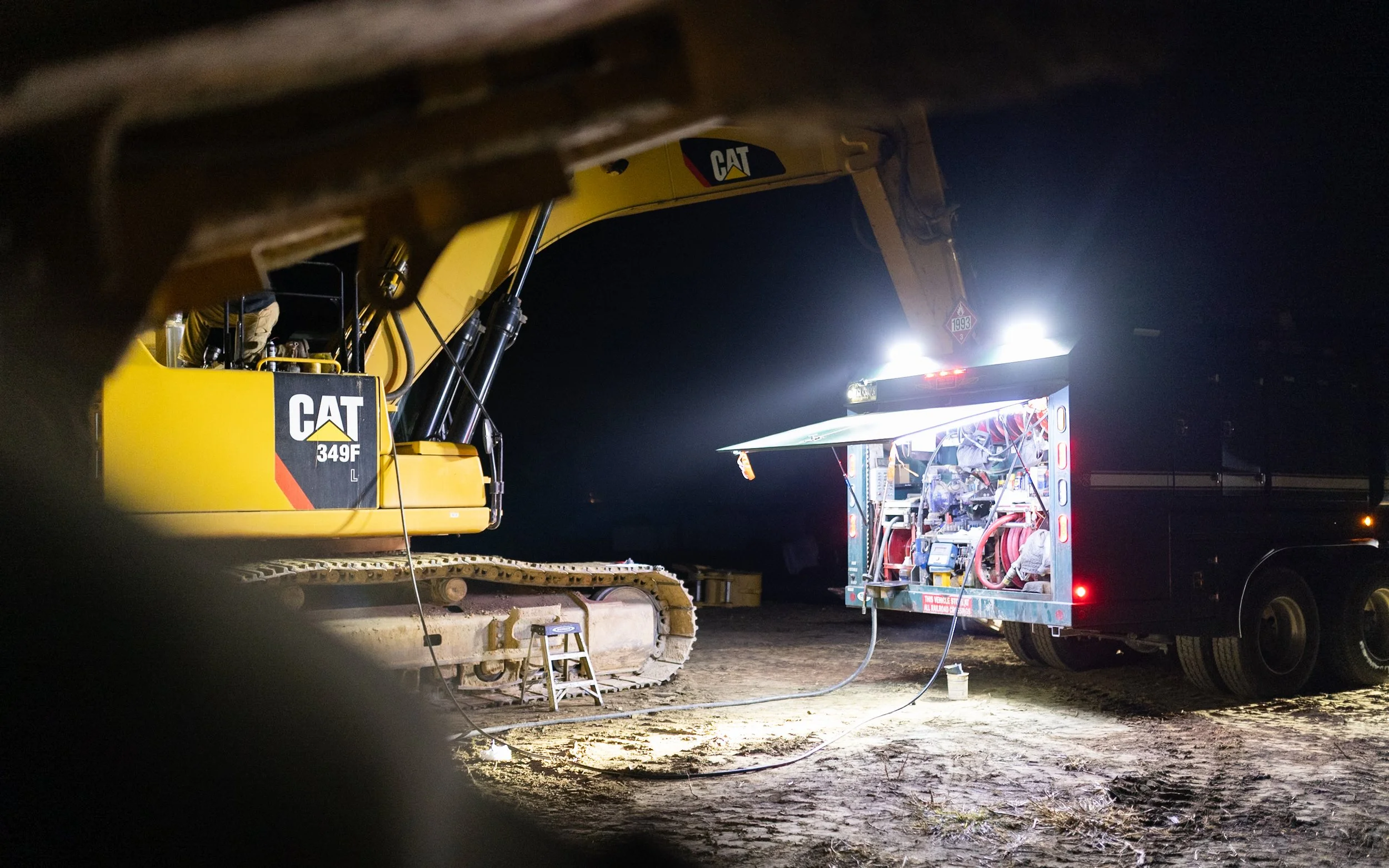
Managing Rising Fuel Costs
Fuel prices of all types may be dramatically increasing in the coming days, weeks, and months due to the supply chain disruptions caused by the conflict in the Middle East. Crude oil prices have increased more than 40% in the past month and may continue increasing for the foreseeable future. Changes in gas and diesel prices at the pump lag behind crude prices, so we have not yet felt the full extent but may soon.
Why It Matters
Every month our company burns thousands of gallons of diesel and gasoline to operate our equipment and vehicles. Unexpected and significant increases in fuel prices are not something we can typically plan for or price into our projects and we do not expect to receive additional compensation from current contracts to make up for the added expense.
We are about to start feeling this direct impact which will add thousands of dollars of cost to the company per month, and this will directly impact our profitability. Unfortunately, we cannot control the price of fuel nor can we control the likely increases in other material and transportation costs that are to follow; however, we can control how we react and operate as a company. Our profitability is not just determined by how skilled we are or how fast and efficiently we can move dirt or lay pipe. Our profitability is directly influenced by every individual and the habits and seemingly insignificant decisions we make daily.
Our profits are the driving factor in our ability to grow and reinvest in our people and equipment. Our profits are what allow us to continue offering higher wages, better benefits, and bonuses to the people who make our success possible.
What To Do
To minimize this impact as much as possible we ask that everyone refocus on what we can control and make elimination of idling and fuel waste a part of your daily priorities. This starts with having a daily conversation with your team to reinforce this priority. Eliminating idling and fuel waste does not mean sacrificing safety or production on the job; it means planning ahead and being aware of and adjusting habits and behaviors that are unnecessary. Eliminating idling and fuel waste saves a significant amount of money in the hidden costs of owning and operating heavy equipment and vehicles. Engine and component wear, repairs, maintenance, service cycles, downtime, ownership, and replacement costs are all accelerated when machines run and burn fuel unnecessarily. These types of costs don’t show up as everyday cash transactions, but they are true expenses that have a real and significant impact.
Please begin implementing and reinforcing the following habits and expectations on your projects by communicating with your teams the importance and impact we each have:
1. Minimize Equipment Idling
If a machine is not being actively utilized shut it off. For example, if an excavator is knowingly going to wait an extended period to load a truck and can’t do something else productive in the meantime, shut it off.
If you exit the machine, even for a few minutes, shut it off. A few minutes frequently turns into longer.
Modern equipment is designed to be started and stopped frequently and the cost of replacing a starter is much less than the cost of idling for as little as 30 hours.
Machines need to warm up before use. Minimizing idling is not meant to reduce proper care of equipment, but there are limited circumstances where a machine needs to warm up for more than 10–15 minutes before use.
The true cost of idling our equipment from small skidsteers to larger excavators ranges from $30 to $100+ per hour when factoring in all ownership and operating costs.
2. Minimize Vehicle Idling
If a vehicle is not being actively driven or used shut it off. There are limited circumstances where a vehicle needs to run on a job for hours on end.
Do not run your vehicle solely to charge phones, iPads, GPS batteries, etc. If you have devices that need to be charged it is your responsibility to ensure it is done in advance.
If we need to purchase more chargers, batteries, or power banks so our tools and equipment are never without power please let me know. The cost of these items is a very small fraction of the cost of running vehicles to charge batteries.
Vehicles are not generators or charging stations. The purpose of a vehicle is to transport people and cargo from one place to another. Idling an F150 for 1 hour is equivalent to driving 33 miles and although the odometer may not be increasing, the wear and tear is.
The cost of idling our F150s is more than $15 per hour when factoring in ownership and operating costs.
Extended idling results in incomplete combustion, causing carbon buildup on spark plugs, clogged catalytic converters, and accelerated engine oil degradation.
Running an F150 for 1 hour per workday for a year for the sole purpose of charging a battery or device costs more than $3,500.
3. Plan Ahead
Spend a few extra minutes at the beginning and end of each day confirming what tools, materials, or supplies are needed for the next several activities and days of work. Be efficient with your time and minimize the number of stops or trips needed to pick up miscellaneous items.
Plan your routes between projects and the office to check off as many tasks as possible. Forgetting one task that requires an additional trip back to a project costs hundreds of dollars in time, equipment, and productivity.
A 1-hour round-trip by a foreman to a nearby Home Depot for a $5 can of glue that should have been planned for in advance has an actual cost of at least $105 but can exceed $800. Yes, a $5 can of glue can actually cost $800.
$75 of labor cost and $20 in vehicle costs for the trip to pick up the material.
$5 across the processing cycle to upload, code, approve, pay, and reconcile a credit card transaction. Every credit card swipe costs an additional $5 to process internally.
Up to $700 in labor and equipment downtime if unable to proceed with productive work or if inefficiencies are caused by supervisor not being on site.
4. Be Mindful of Our People
The company’s bottom line is not the only one affected by fuel prices. Our employees have a cost to commute to the jobsite every single day and an increase in fuel prices reduces everyone’s take home pay.
We need to communicate early and clearly when weather impacts our projects and our ability to work. It is critical to have a plan to minimize employees driving to the project just to be sent home, and we need to implement better practices to maximize productivity and minimize waste.
It is also the responsibility of team members to reach out to their supervisor or foreman when there is questionable weather before making the drive in. A quick call or message can save everyone time, fuel, and frustration.
An example of this may be keeping your team on a delayed start or hold in the morning after a heavy weather event until the project site conditions can be confirmed. Starting a bit later with a guarantee of work for the day after an overnight storm is likely more productive and better for the employees and company compared to having everyone drive in only to find out it’s too wet.
Actions like this require planning, clear communication, and may not always be possible, but we should always be looking for ways to do better.
In Closing
Our work at every level is already challenging and complex without being hindered by external forces we can’t control, but part of our long-term success is defined by our actions and reactions to what we can control. Our ability to not only survive but to grow and succeed starts with the small decisions and daily habits of everybody at Lyons & Hohl. Everyone has the responsibility to minimize waste and maximize efficiency, and it begins with you.